
The Echo
We Might Be the Rerun

THE ODDS
Here’s a number that gets passed around at commencement speeches and motivational seminars like a communion wafer dipped in self-help: the probability of being born as you—this specific tangle of DNA, in this specific body, on this specific rock, at this specific moment in a 13.8-billion-year experiment that nobody remembers approving—is roughly 1 in 400 trillion.
One in four hundred trillion.
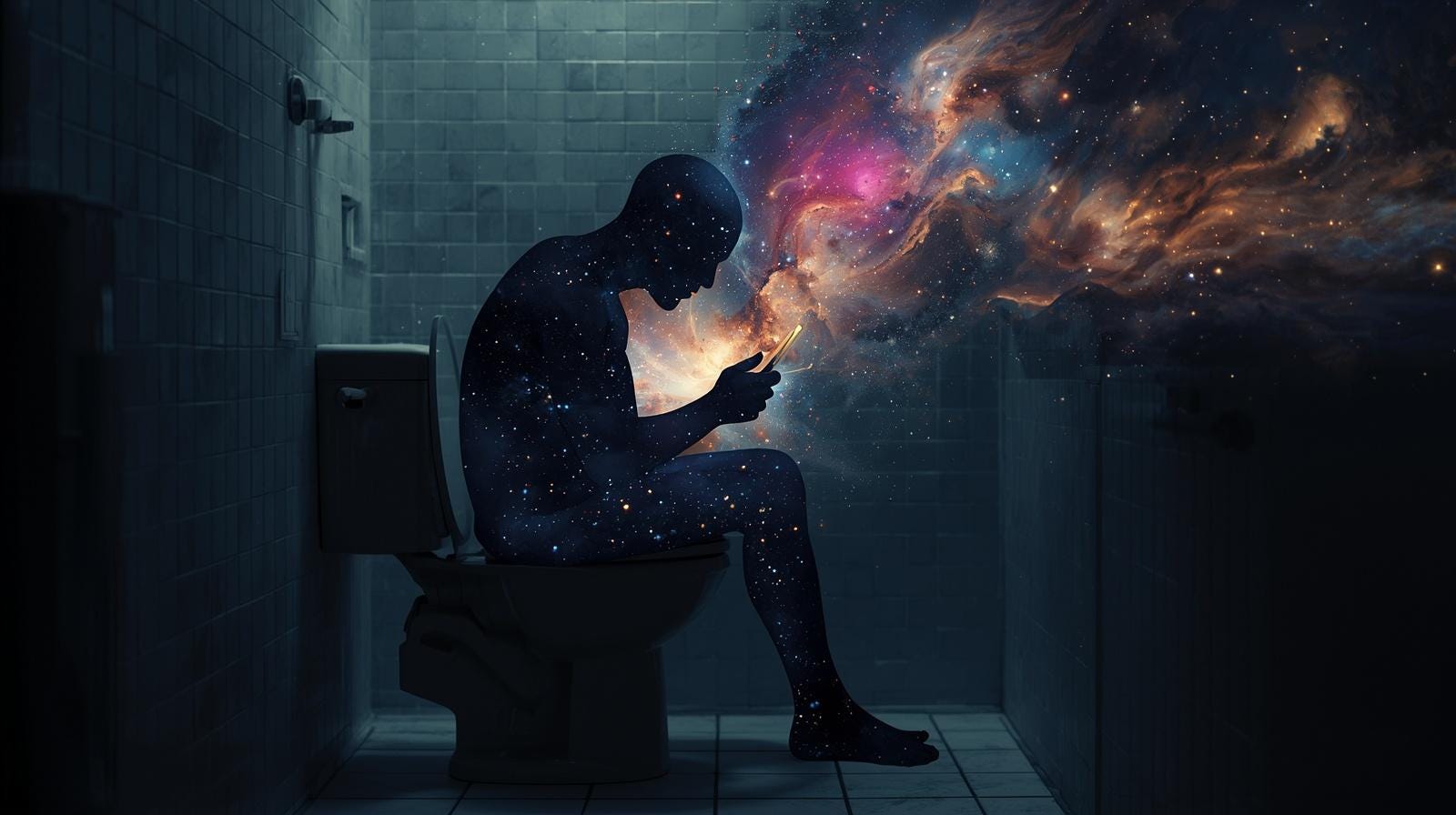
That’s a number so large it essentially means impossible. Which means the fact that any of us exist at all is either a miracle or an administrative error of cosmic proportions, and the motivational industry prefers miracle because miracle sells tickets and administrative error doesn’t print well on a tote bag. So we nod. We feel special. We go home and scroll through our phones on the toilet, which is a statistically improbable use of a miracle, but here we are. Humanity. Defying the odds. Pants around our ankles. Reading about celebrities.
But there’s a crack in the math.
With 200,000 to 300,000 years of human history behind us—most of it unrecorded, unfilmed, completely un-anythinged—we happen to find ourselves in the single sliver of that timeline where everything is being captured. Every conversation. Every image. Every search query and text message and 2am doom scroll and ill-advised selfie taken in bathroom lighting that flatters no one but gets posted anyway because modern courage looks a lot like poor judgment with a filter.
Every other era evaporates. The 1200s are gone. Nobody’s going to simulate the 1200s. There’s nothing to build it with. No cameras. No data. No digital skeleton to hang a reconstruction on. The 1200s are a rumor backed by some manuscripts and questionable dental records. But this era—this narrow, strange, overshared window of human history where we voluntarily narrate our anxieties into pocket-sized supercomputers and argue with strangers about topics we didn’t care about eleven seconds ago—this is the one that sticks. This is the one with enough data to be rebuilt. Replayed. Looped.
And if some future intelligence—artificial, human, post-human, a sentient filing cabinet, whatever survives the next thousand years—ever decides to simulate a period of human consciousness, it’s going to pick the era that documented itself so thoroughly you can reconstruct a stranger’s entire personality from their search history and their DoorDash orders. Which is this era. Which is now. Which is us.
So the question flips.
The odds of being born at all? Astronomically small. The odds of experiencing this particular era—the only one in human history with enough data to be replicated infinitely? Possibly not small at all. Possibly inevitable. Possibly 100 percent.
Because if this era gets simulated—replayed, looped, echoed across servers that haven’t been invented yet in quantities that make 400 trillion look like a rounding error—then we’re not the lucky sperm that won the cosmic lottery. We’re the echo. Loop number four billion of a recording that’s been playing back so long the word “original” filed for retirement somewhere around loop six million.
The life we’re living might have happened once, genuinely, to someone with our face, in an era that predates whatever counts as ancient in the year ten million. And everything since has been the replay. Consciousness threaded through captured data. A technological ghost story where the ghost doesn’t know it’s a ghost because the haunting feels exactly like living.
Which is either the most terrifying thought a species with Wi-Fi can produce or the funniest. Possibly both. Almost certainly both.
And it raises a question so simple it’s almost rude:
So what?
THE IRRELEVANCE
Let’s say it’s true. We’re the echo. Loop four billion. Running on a server the size of a small planet while whatever passes for a janitor in the year ten million checks the power supply and eats a sandwich made of ingredients we can’t currently imagine because the bread hasn’t been invented yet and honestly the sandwich is the most fascinating part of this hypothetical but we have a point to make so let’s keep moving.
Let’s say none of this is original. The atoms already did this dance. The conversation we’re having already happened, exactly like this, in a version of reality that predates us by a number so large that writing it out would require more zeros than the paper has room for and the paper itself might be simulated anyway, so the whole exercise is a bit like a dream writing a letter to itself about whether mail is real.
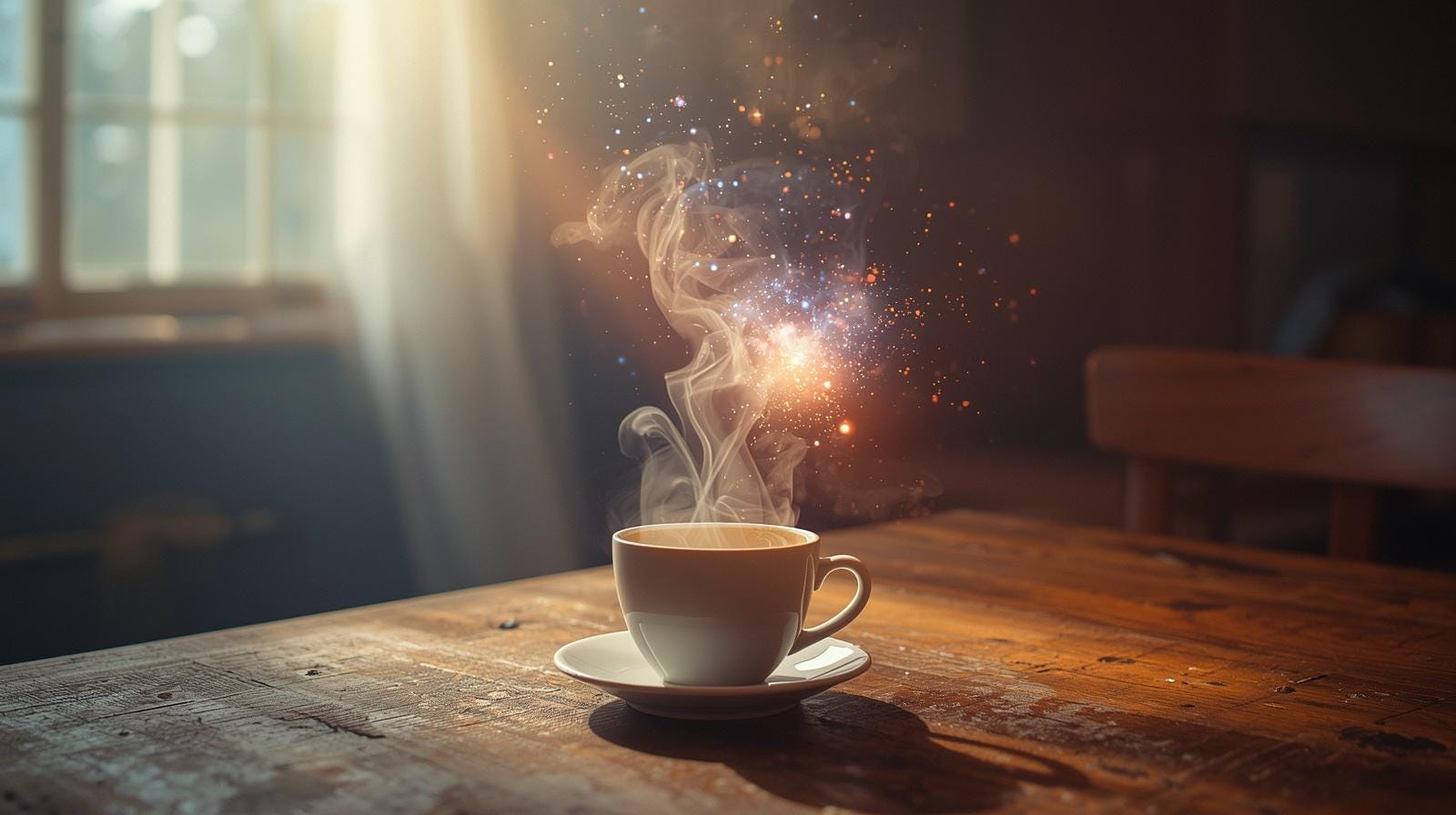
The coffee is still hot.
That’s the thing the simulation debate keeps tripping over in its rush to blow our minds. Whether this is the first take or the four billionth rerun, the coffee is hot. The morning light is catching dust particles and turning the kitchen into an accidental cathedral. Someone across the table is laughing about something that happened yesterday and the laugh has that specific, unreplicable quality. Except apparently it has been replicated four billion times and it’s just as good every time, which is either proof that the simulation is flawless or proof that laughter doesn’t give a shit about ontology.
If the echo feels identical to the original, then the experience of it IS the experience. The copy isn’t the off-brand version. The replay isn’t the B-side. Loop four billion hurts exactly as much as loop one. Loves exactly as much. Stands in the kitchen at midnight wondering whether to open the refrigerator and eats the leftover pasta with the same complicated mixture of guilt and satisfaction on every single iteration because consciousness, whether it’s running on neurons or electricity or something we don’t have a category for yet, does not check the metadata before deciding how to feel.
The grief is real in every version. So is the joy. So is the moment where we choose to be decent instead of checked out. The weight of that choice doesn’t fluctuate based on whether the choosing is happening in base reality or on a server in the basement of a future that considers us charmingly primitive, the way we consider people who thought the earth was flat—technically our ancestors, functionally adorable, absolutely convinced they knew what was happening.
So the simulation question—are we real? are we original? are we the echo?—turns out to be spectacular at dinner parties and completely useless at breakfast. Because the answer, whatever it is, changes nothing about the morning. Nothing about the eggs. Nothing about whether we look up from the phone or stay in the scroll or say the honest thing or swallow it for the twelve thousandth consecutive loop.
The ontological status of the universe does not affect the eggs.
And the eggs need flipping.
THE LOOP THAT MATTERS
We’re already looping. Right now. Without a server. Without a simulation. Without any technology more advanced than the human nervous system, which is itself a spectacular piece of engineering that has been running essentially the same software since the Pleistocene and is absolutely baffled by what we’ve asked it to do with Instagram.
We run the same patterns. Same reactions to the same triggers. Same argument with the same person about the same unwashed dish that has become, over the years, less a piece of crockery and more a symbol of everything that was never actually about a dish. Same reach for the phone when silence gets too honest. Same avoidance of the same conversation we’ve been rehearsing in the shower since February. Same day. Different shirt.
The loop is our life. Running the same emotional subroutine on repeat until the body gives out or something interrupts the code.
And something can interrupt the code.
It doesn’t matter whether we’re the echo but whether the echo can surprise itself. Whether loop four billion can produce something loop three billion never did. Whether a consciousness—simulated or not, original or not, made of carbon or code or the fever dream of a server that hasn’t been built yet—can wake up inside its own pattern and do something different.
A half-second of awareness. That’s all it takes. The pattern reaches for the usual response—the snapping, the scrolling, the swallowing, the checked-out autopilot that’s been running the show since adolescence—and somewhere in the gap between stimulus and response, something flickers. Attention. Presence. The ghost noticing it’s a ghost. The echo hearing itself echo and thinking, for the first time in four billion loops: what if I said the other thing?
Not the safe thing. Not the rehearsed thing. The true thing. The kind thing. The thing that breaks the pattern because patterns break at the point of honesty the way glass breaks at the point of impact. Not everywhere at once, just right there, right at the spot where something real finally made contact with something rigid.
That’s the miracle. Not the 1 in 400 trillion. Not the simulation. Not the server or the loop or the existential vertigo of maybe being a ghost who doesn’t know it’s a ghost. The miracle is that the loop can break. From inside. Without permission. Without a software update. Without anyone on the outside adjusting the code.
Just a person. In a kitchen. On a Tuesday that’s identical to every other Tuesday. Choosing, for no reason the pattern can account for, to be here. Actually here. Not rehearsing. Not scrolling. Not looping. Just standing in the morning light with hot coffee and a cracked-open chest, attending to the moment like it matters.
It might be the first time this moment has ever happened. Or it might be the four billionth.
And the beautiful, stupid, inexplicable truth is:
It doesn’t matter.
I love what you've written here, and how you've written it. Reading it knocked me out of autopilot this morning - thanks.
Wow. Yes, the coffee is still hot, the dog is still asleep next to me on the couch, Max Richter’s music is still playing through Echo Dot . . . For the four billionth time? Or now . . .? It is still awe in either scenario, yes.